Risk Assessment Matrix

Safety
Risk Assessment Matrix: Practical Guide for WHS and Operations Leaders
Turning everyday hazards into clear, prioritised decisions
Summary:
WHS and operations leaders make risk calls every day, often under time pressure and with incomplete information. This article shows how to turn that pressure into a structured, repeatable process using a simple risk assessment matrix. You’ll learn how to map likelihood and consequence, engage supervisors and frontline workers, and connect your assessments to practical controls, monitoring, and digital tools.
1. Why structured risk decisions matter
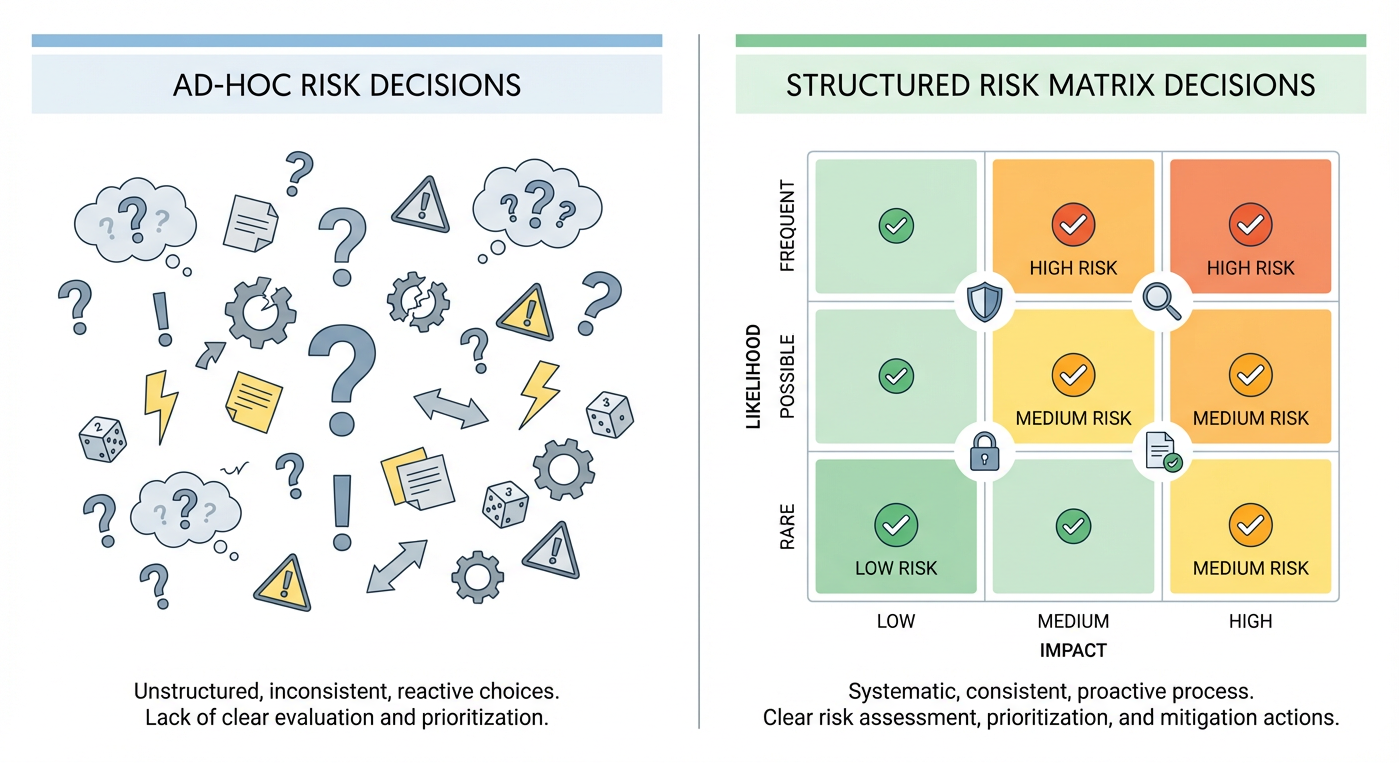
Most organisations don’t fail on safety because they ignore hazards entirely. They fail because risk decisions are inconsistent:
- One supervisor treats a task as routine, another flags it as high risk.
- A near miss triggers a flurry of activity, but similar tasks elsewhere stay unchanged.
- Everyone is busy, so informal judgments replace a documented method.
The result is a patchwork of controls, documentation, and expectations. Incidents, injuries, and close calls often trace back to earlier choices that felt reasonable at the time but weren’t tested against a shared standard.
A structured approach gives you:
- Consistency – two different teams assessing the same task land on similar risk ratings and controls.
- Transparency – leaders, auditors, and workers can see why a decision was made.
- Accountability – it’s clear who assessed the task, when, and on what basis.
- Better conversations – instead of arguing about opinions, people discuss evidence and thresholds.
This is exactly what a well-designed matrix aims to deliver.
2. What a risk matrix actually is (and isn’t)
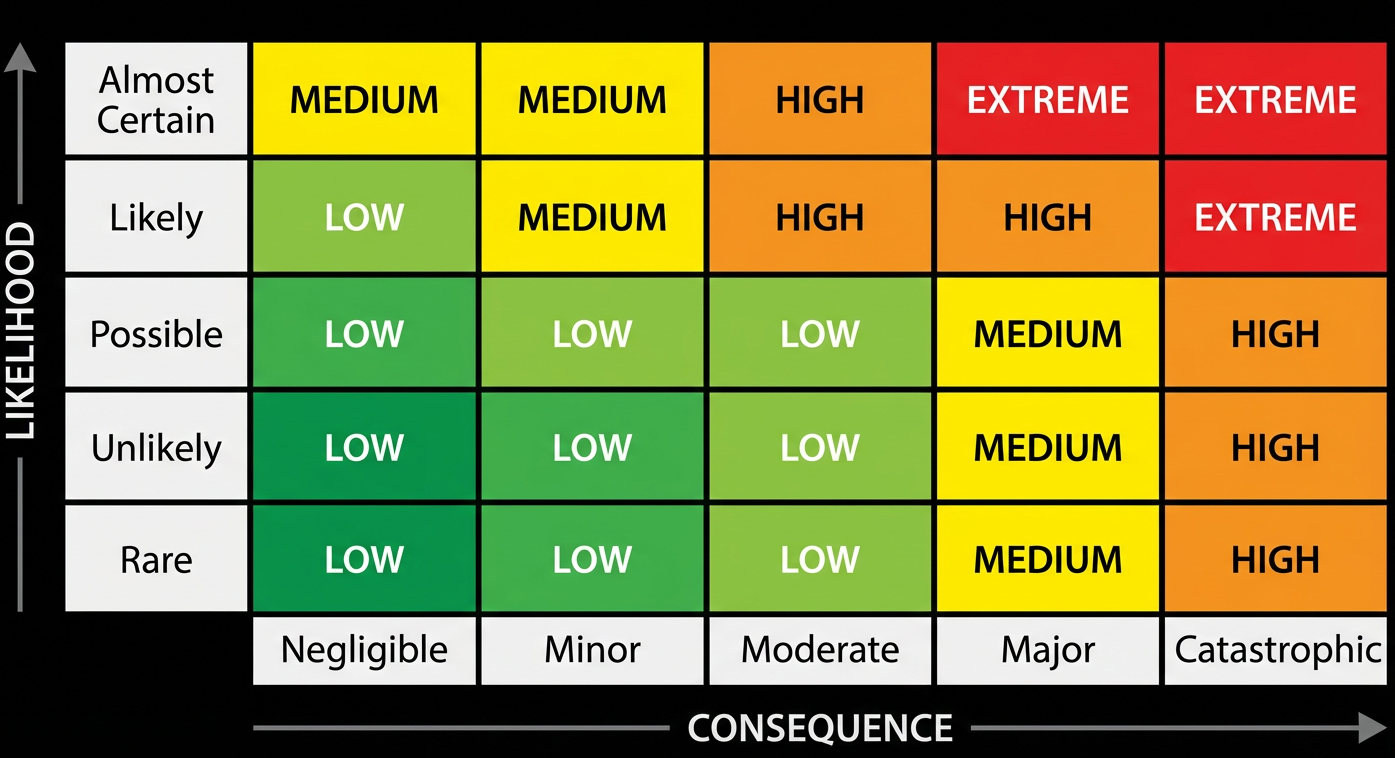
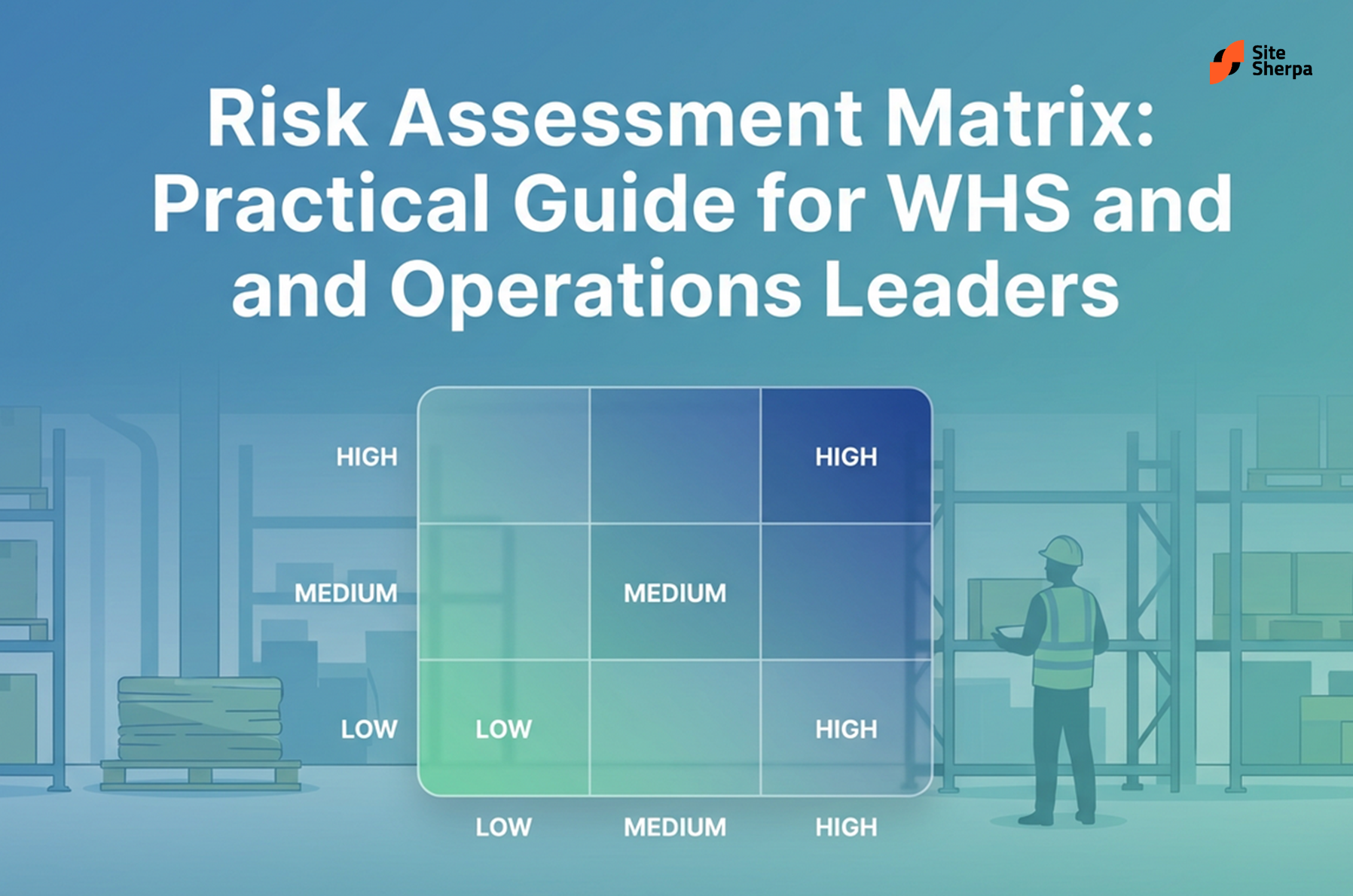
A matrix is a simple decision aid that cross‑references:
- Likelihood – how often an event could happen (e.g. Rare to Almost Certain).
- Consequence – how bad it would be if it did happen (e.g. Insignificant to Catastrophic).
The grid assigns each combination a level such as Low, Medium, High, or Extreme. That level then links to expectations:
- Whether work can proceed.
- What controls are required.
- Who must approve the activity.
A few important clarifications:
- It is not a substitute for competent judgement. It focuses and documents judgement.
- It is not enough on its own. You still need hazard identification, controls, consultation, and monitoring.
- It should be tailored to your risk profile, industry, and WHS obligations.
When leaders treat the tool as a living part of their safety management system, it shifts from a tick-box graphic to a shared language for risk.
3. Designing a matrix that fits your organisation
Before you roll out a new matrix or refresh an old one, step back and design it deliberately.
3.1 Define clear likelihood levels
Common scales use five levels. For example:
- Rare – could happen only in exceptional circumstances.
- Unlikely – not expected but has happened in the industry.
- Possible – might occur at some time during normal operations.
- Likely – expected to occur in many circumstances.
- Almost Certain – will occur frequently in the current conditions.
Keep descriptions concrete. Where possible, link them to real data:
- Historical incident frequency.
- Exposure counts (e.g. number of lifts per week, number of entries into a confined space).
3.2 Define consequence levels
Again, five levels work well when the language is plain and tied to real impacts:
- Insignificant – first aid only, no time lost, negligible cost.
- Minor – medical treatment, small property damage, short disruption.
- Moderate – lost time injury, moderate damage, some production downtime.
- Major – serious injury, significant damage, extended outage.
- Catastrophic – fatality or permanent disability, major asset loss, business‑critical disruption.
Where WHS legislation or industry codes specify thresholds (e.g. notifiable incidents), align your definitions so the matrix reinforces your statutory duties.
3.3 Agree the colour scheme and rating logic
The familiar green‑amber‑red palette helps people scan quickly. What matters is:
- Thresholds – e.g. at what point does a scenario move from Medium to High?
- Rules – e.g. “No High or Extreme risk task proceeds without written approval and documented controls.”
Document these rules in your WHS management system so that the graphic is backed by clear governance.
4. Building the process around the matrix
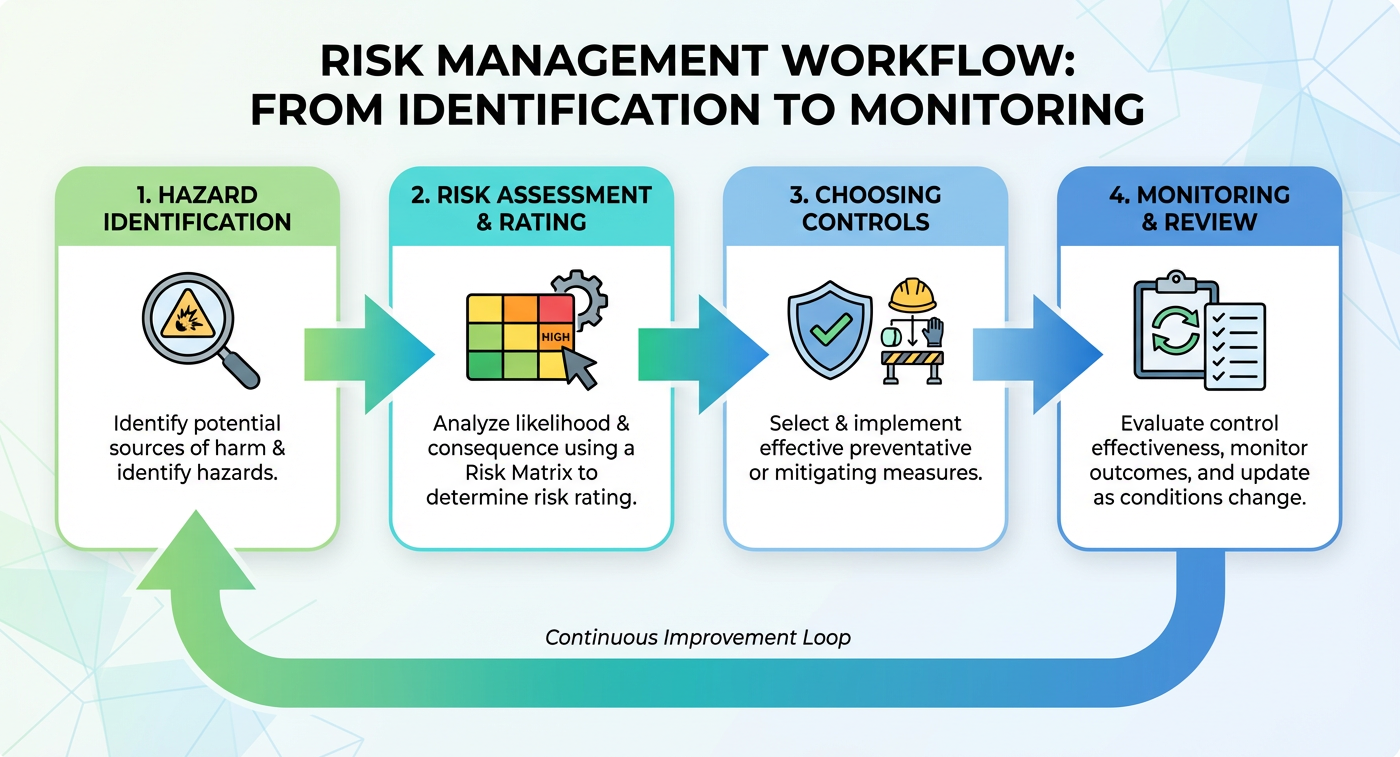
The most common mistake is to publish a matrix in a procedure but not embed it in day‑to‑day work. To avoid that, design the surrounding workflow.
4.1 Start with solid hazard identification
You cannot rate a risk you haven’t identified. Strengthen your inputs by:
- Running task observations and walk‑throughs with supervisors and workers.
- Reviewing incident, near miss, and safety alert data.
- Including contractors and HSRs in discussions about high‑risk activities.
Every time you update plant, processes, or staffing, revisit the underlying assessments.
4.2 Use the matrix to rate current and residual risk
For each identified hazard:
- Describe the scenario – who could be harmed, doing what, under what conditions.
- Rate the inherent risk assuming existing controls fail or are absent.
- List current controls (engineering, administrative, PPE) and assess how reliable they are.
- Rate the residual risk using the same matrix.
Capturing both inherent and residual ratings helps focus improvement efforts:
- If inherent risk is Extreme but residual is Medium, you know critical controls must be rock‑solid.
- If residual is still High, you have a clear signal to redesign the task or introduce stronger measures.
4.3 Link ratings to decision rules
Without explicit rules, people will interpret colours differently. Examples of practical rules:
- Low – Manage with routine procedures and local supervision.
- Medium – Implement and document controls; review at least annually or after change.
- High – Senior leader approval required; detailed Safe Work Method Statement and permit where relevant.
- Extreme – Do not proceed. Redesign the work or add substantial controls before reassessment.
Write these triggers into your WHS management plan, permits, and work authorisation processes so that the matrix outcome drives clear actions.
5. Using the matrix in daily operations
Once the foundation is set, bring the tool into everyday conversations.
5.1 Toolbox meetings and pre‑start briefings
Use pre‑start talks to walk through today’s critical tasks:
- Ask the team which hazards concern them most.
- Pick one or two tasks and quickly rate them using the matrix on a whiteboard or tablet.
- Compare the rating with your documented assessment. If they differ, dig into why.
This builds both engagement and confidence that documented controls match what workers are seeing in the field.
5.2 Permits and high‑risk construction work
Activities like working at heights, confined spaces, or energised electrical work, require that permits:
- Reference the relevant assessment.
- Include the current residual rating.
- Spell out the controls that bring the rating down to an acceptable level.
This gives supervisors a defensible, consistent basis for signing off work.
5.3 Incident reviews and audits
When incidents or near misses occur, go back to the original rating:
- Was the likelihood underestimated?
- Were controls assumed to be in place when they weren’t?
- Has equipment condition, workload, or staffing changed?
Use findings to update the assessment, adjust the matrix if required, and improve training.
6. Digital tools, dashboards, and integration
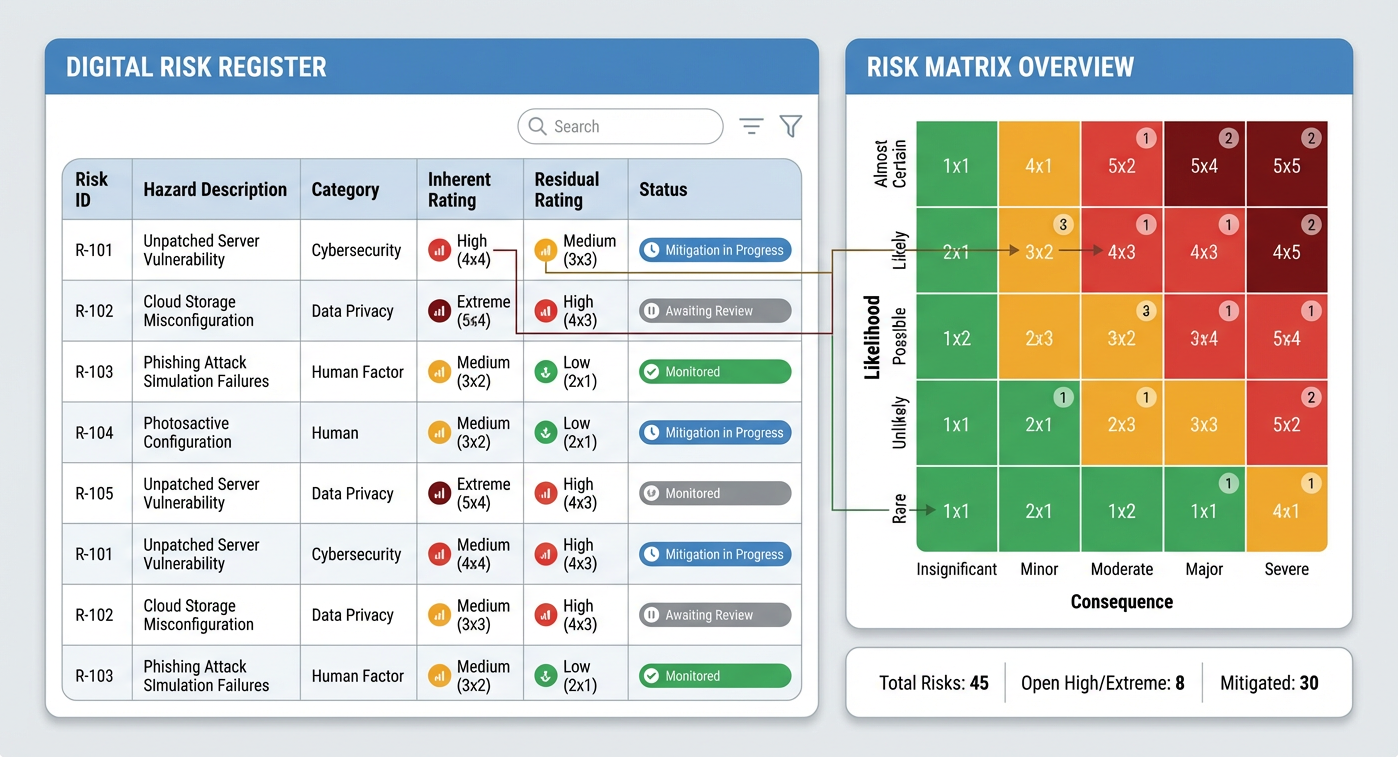
Paper‑based matrices quickly become hard to manage across multiple sites. A digital approach can help WHS and operations leaders:
- Maintain a central library of assessments linked to tasks, assets, and locations.
- Track who last reviewed each scenario and when.
- Surface trends, such as repeated High ratings for similar tasks or equipment.
- Link ratings directly to permits, SWMS, and contractor documentation.
Modern platforms allow you to:
- Pre‑configure your likelihood and consequence scales.
- Force selection of both inherent and residual ratings.
- Trigger workflows when a High or Extreme rating is chosen.
- Provide simple dashboards for leadership and boards.
7. Common pitfalls and how to avoid them
Even well‑designed tools can be undermined by everyday pressures. Watch for these pitfalls:
- Over‑simplification – Using one generic matrix for every hazard, from manual handling to chemical exposure, without considering specialist guidance.
- Wishful thinking – Rating likelihood as Rare because you intend controls to be followed, not because they actually are.
- Lack of training – Assuming supervisors and workers understand the scale without structured training and examples.
- Frozen documents – Never updating ratings after changes to plant, process, workforce, or incident trends.
- No link to action – Colour ratings that sit in documents but never influence permits, budgets, or scheduling.
Mitigate these by:
- Running short, scenario‑based training sessions.
- Building reviews into change management and audit schedules.
- Regularly sampling tasks to test whether documented controls match reality.
8. Bringing it all together for WHS and operations leaders
For WHS managers, operations leads, and business owners, the value of a well‑governed matrix is straightforward:
- Faster, more consistent decisions under pressure.
- Clear documentation for regulators, insurers, and internal governance.
- Stronger engagement with workers who can see how their input shapes risk ratings.
- A foundation for digital tools that give real‑time visibility of organisational risk.
Used well, this approach turns complex hazards and competing priorities into structured, defensible choices that keep people safer and operations more reliable.
In your own workplace, choose one high‑risk activity this week and walk through the full process with your team. Capture the scenario, use the risk assessment matrix to rate it, confirm or improve your controls, and update your documentation. Then schedule a review in a few months to see whether the rating — and the real‑world risk — has changed.
By treating each assessment as a chance to learn, you move from reactive problem‑solving to a proactive culture where structured decisions are the norm.
Disclaimer
At SiteSherpa, we follow the Model Work Health and Safety (WHS) Act, along with other relevant legislation, regulations, and codes of practice applicable to Australia, to ensure our content reflects industry best practices. Our resources are designed to provide helpful guidance, but they don’t replace professional advice or legal requirements. We do our best to share accurate and reliable information, but businesses should always check their specific WHS obligations to stay compliant and keep their workplaces safe.
Related Content

Join Our Newsletter
Receive expert insights, safety updates, and the latest updates in our services and apps. Stay ahead of workplace safety, compliance, and operational efficiency—delivered straight to your inbox.
By clicking Subscribe you're confirming that you agree with our Terms and Conditions.